3I/ATLAS, an enigmatic celestial visitor, is shedding extraordinarily large particles unlike any comet observed before, defying all conventional cometary behavior and scientific expectations. This mysterious object challenges existing astronomical models with an unprecedented sunward jet structure and anomalous particle ejections, raising urgent questions about its nature and origin.
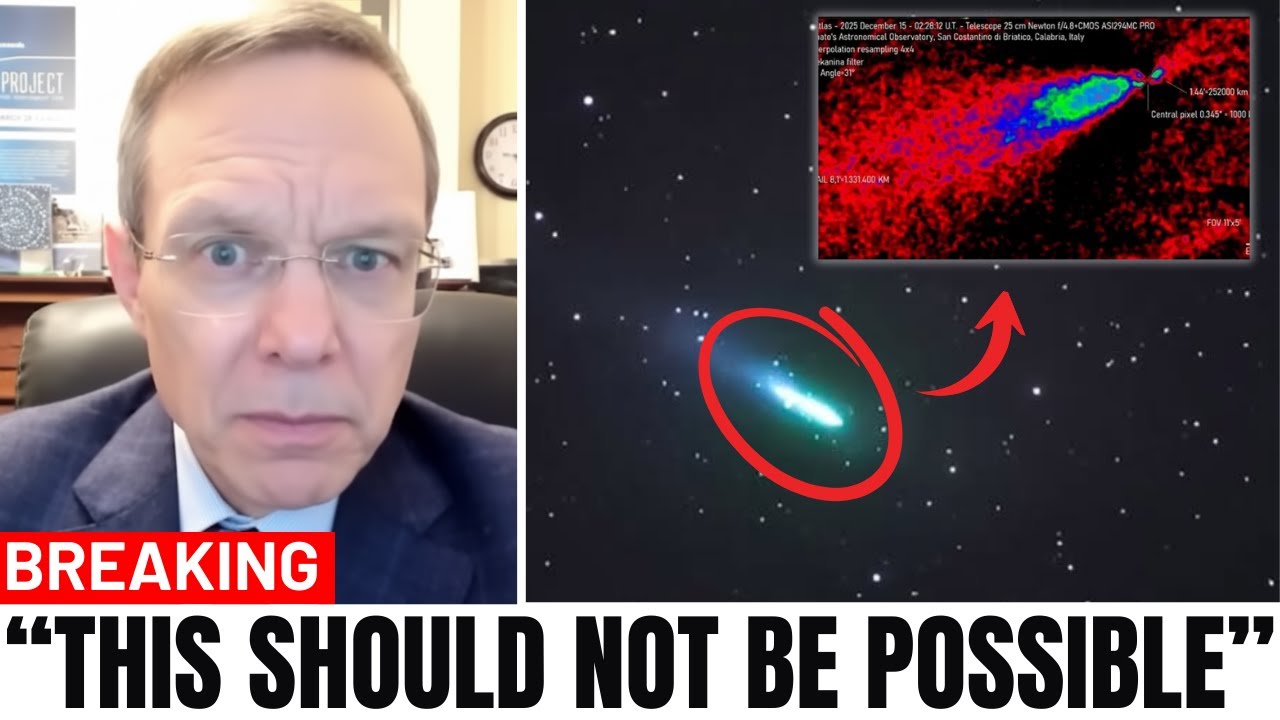
Scientists tracking 3I/ATLAS observed an astonishing boost in its velocity caused by a recoil effect comparable to a jet expelling five billion tons of matter. Such an immense thrust is unlike anything typical comets produce, signaling an unknown mechanism driving this object’s acceleration through space.
Detailed imaging reveals 3I/ATLAS releasing particles far larger than typical comet dust, forming a razor-thin, tightly collimated anti-tail stretching hundreds of thousands of kilometers directly toward the sun. This sharply contrasts the usual diffuse, fragile dust tails of comets, which scatter quickly under solar radiation pressure.
Normal cometary dust, made of microscopic grains, disperses rapidly in sunlight. Yet, the particles from 3I/ATLAS remain coherent and tightly packed, defying the dispersive forces that should have destroyed such a structure over vast distances. It’s clear these particles are of an unusual, much larger scale.
This macroscopic particle size distribution does not align with any known comet models. Unlike typical comets where small dust dominates, 3I/ATLAS is shedding predominantly large particles—a profound anomaly that overturns long-held understandings of cometary mass loss and jet behavior.
Observers emphasize this is not a minor irregularity but a fundamental physical anomaly. The continuous, narrow sunward jet remains stable across extreme environmental conditions, requiring a complete reassessment of comet-like objects. This phenomenon is compelling astronomers to question the very assumptions underpinning solar system science.
Complicating matters, radio telescope scans on July 2, 2025, by the Allen Telescope Array uncovered no detectable radio emissions from 1 to 9 gigahertz associated with 3I/ATLAS. Despite recording millions of signals initially, rigorous filtering left no credible radio source linked directly to the object’s location.

This profound radio silence imposes severe limits on possible interpretations. Its isotropic radiated power in radio bands is constrained to below 10 to 110 watts—astonishingly faint compared to human-made transmitters. Additional searches with the Green Bank Telescope tightened this limit to approximately 0.1 watt.
While consistent radio silence does not imply an absence of activity, it rules out many exotic explanations involving strong radio emissions. The object’s substantial size—estimated around one kilometer in diameter—reveals it as a sizable body, not a mere fragment or small debris, reinforcing the puzzle of its behavior.
Calculation of non-gravitational accelerations, caused by mass ejection recoil, combined with particle size estimates, strengthens the view of a large nucleus producing unusual dynamics. The object is shedding large particles yet moving in a way that defies current comet physics and challenges mass loss rate assumptions.
The object’s retrograde orbit remarkably lies closely aligned with the solar system’s ecliptic plane—an improbable coincidence for an interstellar visitor from a random cosmic direction. This peculiar orbital geometry, combined with its unusual timing relative to planetary positions, deepens the mystery and raises pressing questions.
3I/ATLAS’s sunward jet remains tightly collimated despite a dramatic 16-degree gravitational deflection during its perihelion passage. This persistent alignment demands an extraordinary geometric configuration: the rotation axis nearly aligned with the sun, and the jet source extremely near the rotational pole.

Such precise orientation is statistically improbable for a random space object. The jet’s behavior persists with minimal oscillation, demonstrating a highly stable and specific activation mechanism limited to sunlit regions—unlike the more widespread cometary outgassing typically observed near perihelion.
Spectroscopic analyses add another layer of complexity. The gas ratios detected deviate dramatically from those in known comets, featuring unusually high nickel to iron proportions and an unexpectedly low water content. Water, usually dominant in comet composition, is minimal here, challenging established comet formation theories.
The object’s coma also exhibits extreme polarization behavior and rapid brightening exceeding any comet previously documented. Its blue coloration, distinct from the sun’s spectrum, pushes the boundaries of known cometary optical properties and signifies an intriguing and unexplained composition or surface process.
Each anomaly alone would be remarkable; together, they represent a confluence of improbabilities that compel deeper scrutiny and skepticism about standard comet classifications. 3I/ATLAS behaves as a singular outlier that defies multiple expectations simultaneously, making it a landmark object in interstellar studies.
As 3I/ATLAS recedes and fades from observation, opportunities to study its phenomena diminish. Researchers face the pressing challenge of reconciling its unusual particle ejection, strict geometric jet alignment, composition, and radio silence into a cohesive understanding before it disappears forever.

This extraordinary object forces the scientific community to confront the limits of current cometary and interstellar object models. The accumulating anomalies challenge the comfort zone of predictable space phenomena and emphasize the potential for unknown astrophysical processes or bodies beyond our existing frameworks.
The enduring mystery of 3I/ATLAS serves as a stark reminder that the universe often defies simple explanations, compelling scientists to question assumptions and explore new frontiers of knowledge. Its passage could rewrite concepts about interstellar visitors and redefine the boundaries of cometary science.
As unprecedented data and complex models are analyzed, the central question remains: what is 3I/ATLAS truly, and how does it maintain such unusual behavior? No simple answers have emerged, underscoring the urgent need for continuous observation and theoretical innovation in understanding this remarkable object.
The scientific world watches closely, grappling with an object that is neither a typical comet nor fitting current paradigms. 3I/ATLAS’s passage may soon shift from anomaly to groundbreaking discovery, but for now, it remains an unsettling enigma urging a rethink of cosmic processes.
This breaking revelation about 3I/ATLAS demands immediate attention. Its unprecedented shedding of huge particles, stable, narrow sunward jets, and radio silence question long-standing astrophysical concepts. With observing windows closing, the race to decode its secrets is urgent and critical for future astronomical insight.