A colossal rupture in the sun’s atmosphere, spanning a width equivalent to sixty Earths, is currently directing a torrent of high-speed solar wind directly at our planet, coinciding with unprecedented readings from terrestrial monitoring stations and the close approach of a confirmed interstellar object. Designated a trans-equatorial coronal hole by solar physicists, this vast opening in the sun’s magnetic field is unleashing a sustained stream of charged particles, elevating geomagnetic activity as our planet’s defenses come under pressure.
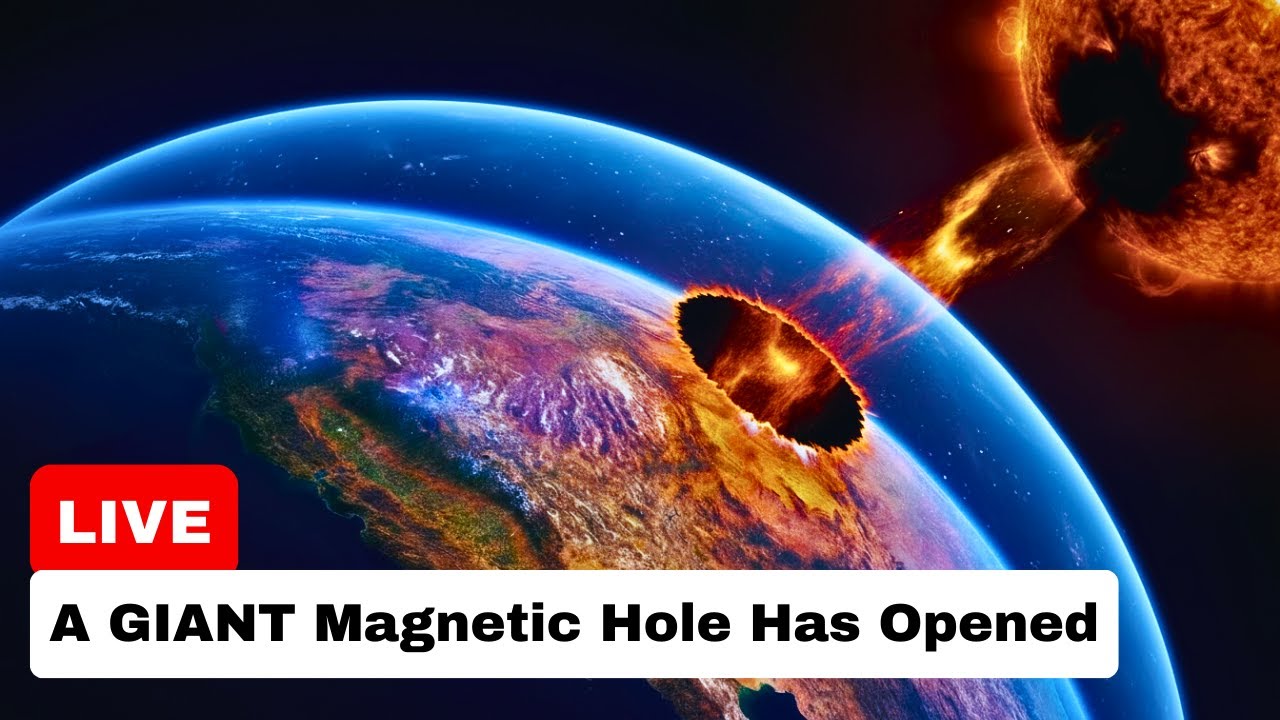
The phenomenon follows a significant solar eruption on December 6th, 2025, when active region 4299 unleashed an M8.1-class solar flare and a subsequent coronal mass ejection (CME) that struck Earth’s magnetosphere on December 9th. While forecasted accurately as a strong G3 geomagnetic storm, the event’s effects were amplified by the pre-existing coronal hole, creating a compounded space weather event that painted auroras deep into mid-latitudes and caused brief radio disruptions.
What has scientists and observers intently focused, however, is the unusual convergence of celestial events. The appearance of such a massive coronal hole this late in Solar Cycle 25, as the sun approaches its maximum, defies typical models. Simultaneously, the interstellar object dubbed ‘Threeey Atlas,’ only the third such visitor ever confirmed, makes its closest approach to Earth on December 19th, passing within 1.8 astronomical units.
This cosmic timing has fueled intense speculation in online forums and alternative science communities, where voices are connecting disparate data points into a alarming narrative. Claims are circulating that Earth’s magnetic shield is experiencing localized failures, particularly over seismically active regions like California’s San Andreas Fault, based on interpretations of magnetometer data showing anomalous fluctuations.

Mainstream scientific institutions strongly contest the more extreme assertions. NASA, NOAA’s Space Weather Prediction Center, and leading solar physicists maintain that while the solar activity is notable, it is within the bounds of known space weather. The magnetic field is dynamic and stressed, but not failing. Fluctuations detected near fault lines are attributed to normal induction effects from geomagnetic storms or local geological processes, not a global collapse.
“The coronal hole is significant and its persistence is driving enhanced solar wind, leading to active geomagnetic conditions,” stated a lead analyst at NOAA’s SWPC, speaking on background. “However, comparisons to catastrophic failure or external influence from interstellar objects are not supported by our data or physical models. Earth’s magnetosphere is operating as designed.”

The object Threeey Atlas itself is under intense scientific scrutiny. Observations confirm it is a carbon-dioxide-rich comet exhibiting a complex, wobbling jet structure from its nucleus. While its composition offers a pristine sample of material from another star system, its gravitational and electromagnetic influence at such a vast distance is considered negligible by astrophysicists. The scientific consensus holds its coincidental timing with solar activity as just that—a coincidence.
Yet, the underlying data reveals genuine mysteries. The South Atlantic Anomaly, a known weak spot in Earth’s magnetic field where radiation levels are elevated, continues to expand and shift westward. While a documented feature for centuries, its growth is monitored closely due to its impact on satellite and spacecraft electronics. Furthermore, the sun’s current behavior, with large coronal holes appearing near solar maximum, indicates our star’s magnetic dynamics are more complex than simplified models predict.

This complexity is the core of the real story. Humanity’s ability to observe the sun in real-time, track interstellar visitors, and monitor our planet’s magnetic field with high precision is unprecedented. The Parker Solar Probe is diving through the solar corona, the James Webb Space Telescope is analyzing the chemistry of Threeey Atlas, and global networks of magnetometers are logging every fluctuation.
What we are witnessing is not a silent countdown to catastrophe, but a noisy, simultaneous broadcast of multiple extraordinary cosmic processes. The sun is in an active and somewhat unpredictable phase. An artifact from another star is passing through our neighborhood. Our planet’s ancient magnetic shield is engaged in a constant, dynamic dance with stellar forces.
The convergence is a powerful reminder of our place in a active solar system and a testament to our growing capability to understand it. While the shield is not down, it is being tested—and so is our capacity to distinguish between the awe-inspiring reality of space science and the compelling fiction of cosmic conspiracy. The answers lie not in fear, but in the relentless, incremental analysis of the data streaming in from the frontiers of space.