A celestial object that has baffled scientists for months has just presented its most profound mysteries yet, with new data suggesting it is behaving unlike anything ever observed in our solar system. The enigmatic 3I/ATLAS, already noted for its peculiar trajectory and composition, is now confirmed to be ejecting material of staggering size and weight, defying conventional cometary physics and forcing a radical re-evaluation of its nature.
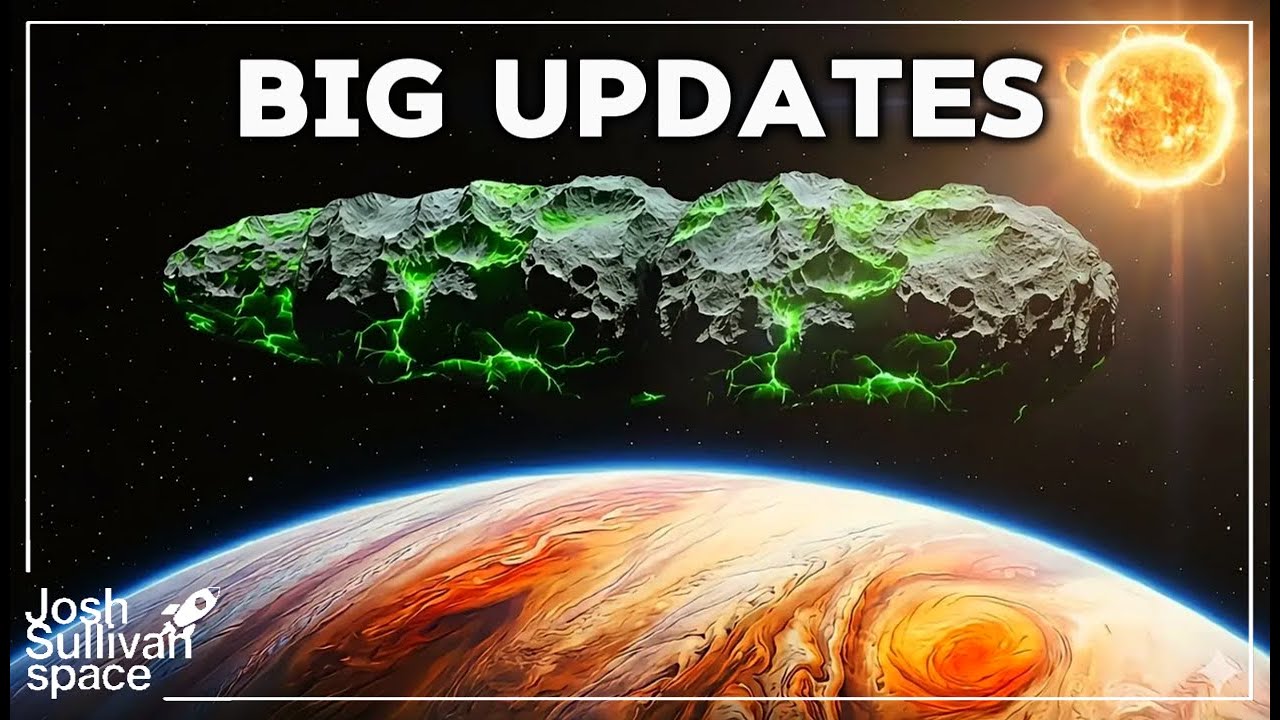
Harvard astronomer Avi Loeb, in findings published December 26, reports the object is releasing dust particles approximately one million times heavier than typical comet dust. These particles, with radii near 100 micrometers, are colossal compared to the one-micrometer specks common to comets. This discovery was independently corroborated by a team led by UCLA’s David Jewitt, adding significant weight to the extraordinary claim.
This revelation directly explains the object’s most visually striking anomaly: a massive, sunward-pointing “anti-tail” stretching an astonishing 400,000 kilometers, roughly the distance from Earth to the Moon. While perspective can create illusory anti-tails, multi-angle observations over months confirm this is a real, physical jet of material streaming toward the Sun, a phenomenon violently at odds with standard comet behavior.
Solar radiation pressure typically blows fine cometary dust away from the Sun, creating the iconic tails we observe. For minuscule particles, this force is so strong it would reverse any sunward motion within mere thousands of kilometers. The existence of a 400,000-km anti-tail is therefore physically impossible for normal cometary material. The only viable explanation is the presence of exceptionally massive particles, like those now detected, which can coast sunward for vast distances before being halted.

This solution, however, spawns a deeper conundrum. Ejecting such massive particles requires immense force. Jewitt’s team calculated these 100-micrometer particles are launched at a lethargic 2 meters per second—barely walking speed. This is far slower than the explosive ejections seen in typical comets, suggesting a fundamentally different ejection mechanism is at work on 3I/ATLAS.
The plot thickens with a parallel mystery surrounding the object’s core size. Earlier observations, based on a puzzling lack of measurable non-gravitational acceleration, suggested a nucleus at least 5 kilometers wide. New December measurements focusing solely on carbon dioxide gas emissions, however, indicate a core of only about 1 kilometer. The discovery of giant, slow-moving particles may bridge this discrepancy.

Loeb proposes a groundbreaking theory that unites these puzzles, rooted in 3I/ATLAS’s bizarre chemical makeup. Data from the James Webb Space Telescope reveals it is 87% carbon dioxide ice and only 4% water ice—a complete inversion of typical solar system comets. Loeb suggests that as the object warms, carbon dioxide sublimates first, creating powerful jets.
These jets, he theorizes, are not blowing away fine dust but are instead ripping off entire fragments of water ice. The carbon dioxide gas, being light, is quickly pushed by solar radiation to form the traditional tail. The heavier, slower-evaporating water ice chunks, however, continue their initial sunward trajectory, creating the persistent anti-tail and explaining the detection of gigantic “dust.”

This ice-fragment hypothesis could also clarify the size paradox. The early undetectable acceleration might be due to the slow, massive ejection of these ice chunks, which impart minimal thrust compared to the violent outgassing of smaller comets. As the object neared the Sun and activity intensified, the acceleration finally became measurable, leading to the revised, smaller size estimate.
The implications of these findings are profound. If confirmed, 3I/ATLAS is not merely an odd comet but a previously unclassified type of interstellar object. Its composition and mechanics suggest formation in an environment utterly different from our own solar system, offering a direct physical sample from an alien star system. The object continues its journey, now heading toward Jupiter, leaving a trail of questions that are reshaping planetary science.
Astronomers worldwide are now urgently directing telescopes toward 3I/ATLAS, seeking further data to test Loeb’s ice-fragment theory. Each observation peels back a layer, revealing not just the secrets of a single strange visitor, but potentially forcing a rewrite of the textbooks on how celestial bodies form and behave across the galaxy. The truth, it seems, is not only out there—it is barreling through our solar system and challenging our most fundamental assumptions.