A colossal rupture in the sun’s atmosphere is currently aimed directly at Earth, firing a relentless stream of charged plasma at our planet and coinciding with a disturbing series of major seismic events across the globe. This unprecedented solar phenomenon, a trans-equatorial coronal hole of staggering size, is forcing scientists to confront unsettling questions about the hidden connections between our star and our planet’s tectonic fury.
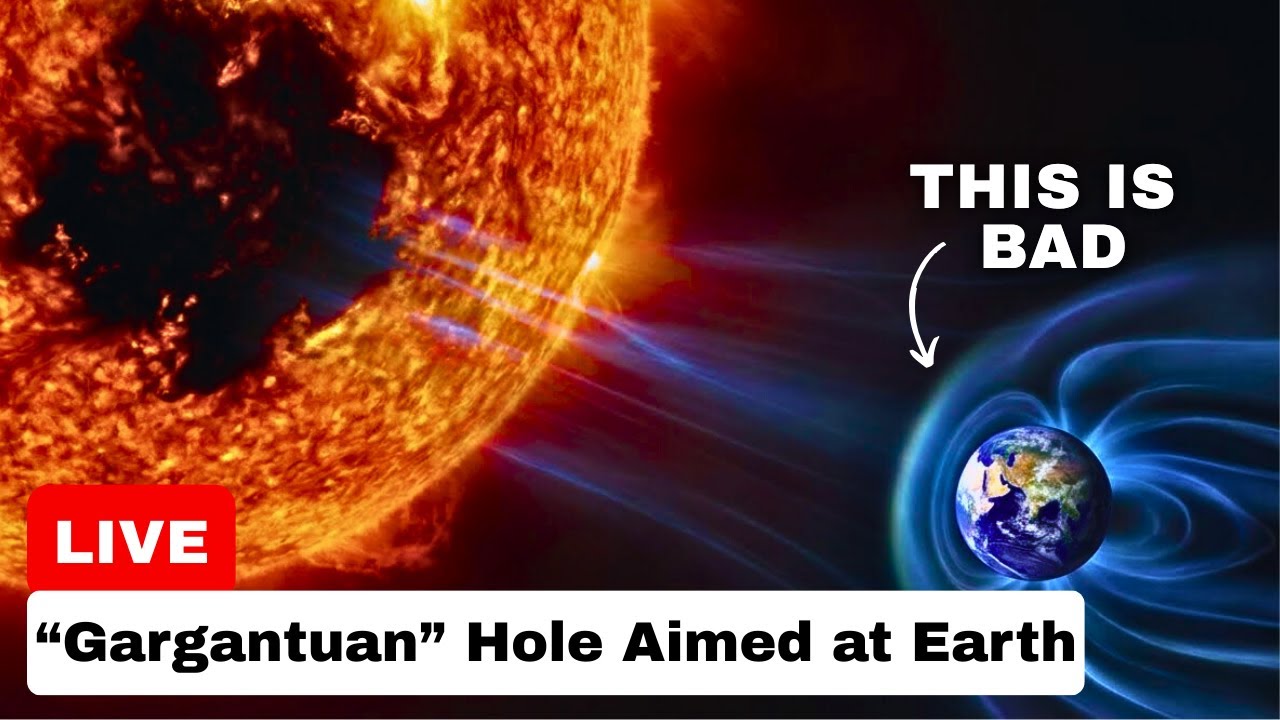
The structure, visible in specialized ultraviolet imagery, is not a typical dark spot. It is a gargantuan chasm stretching from the sun’s northern pole to its southern one, crossing the solar equator. This positioning means Earth is now perfectly aligned in its line of fire, subjected to a sustained solar wind gust exceeding 700 kilometers per second.
Coronal holes are regions where the sun’s magnetic field opens into space, allowing solar plasma to escape as a fast stream. While common during the declining phase of the 11-year solar cycle, this hole’s scale and geometry are exceptional. The SETI Institute has noted its unusual persistence and direct Earth-facing orientation.
The immediate terrestrial impacts are measurable and ongoing. The high-speed wind compresses Earth’s protective magnetosphere, triggering geomagnetic storms classified up to G3 level. These storms amplify auroral displays but also risk satellite drag, radio blackouts, and power grid fluctuations at high latitudes.
Yet, a far more provocative pattern is emerging on the ground. As this solar cannon has bombarded our magnetic shield, the planet has answered with a series of deep tectonic ruptures. The timeline is striking.

On December 8, a magnitude 7.6 earthquake struck off the coast of Japan. This was followed by significant aftershocks. Then, on December 22, a magnitude 6.5 deep-focus earthquake occurred near Papua New Guinea. These are not isolated incidents but part of a year of elevated global seismicity, including a massive magnitude 8.8 quake in Russia earlier in 2025.
The official scientific position from agencies like the USGS is unequivocal: this is coincidence. There is no proven causal link between space weather and earthquakes. The forces of plate tectonics operate independently of solar activity.
However, a persistent fringe of research points to tantalizing, if controversial, correlations. The hypothesis centers on electromagnetic coupling. When solar wind disturbs the magnetosphere, it induces powerful electrical currents in the ionosphere and even within the Earth’s crust, known as telluric currents.
The speculative question is whether these induced currents could provide a subtle nudge to faults already critically stressed, altering pore pressure or friction to advance the timing of an inevitable rupture. The prolonged nature of coronal hole events, lasting weeks, provides a sustained perturbation window.

Adding to the intrigue is a seismic forecast born from conventional physics. The deep Papua New Guinea quake sent seismic waves converging at its antipode—the point directly opposite on the globe—near the seismically active Mid-Atlantic Ridge. This antipodal focusing effect creates a non-negligible probability of a triggered, moderate quake there in the coming days.
Furthermore, some researchers monitoring the ionosphere have reported pre-seismic anomalies, disturbances that appear days before large quakes. These signals, however, are notoriously difficult to distinguish from the intense noise generated by the same geomagnetic storms now raging.
The visual coincidence is perhaps the most unnerving. The coronal hole’s shape, as seen in solar imagery, bears an uncanny, if meaningless, resemblance to the outline of Japan—the nation recently rocked by the 7.6 event. This pareidolia underscores the human struggle to find pattern in chaos.

What remains is a profound mystery at the intersection of heliophysics and geophysics. We are witnessing two parallel narratives: a star undergoing a violent atmospheric disruption and a planet releasing pent-up energy in violent jolts. Mainstream science sees separate stories.
Yet the synchronous timing challenges that comfortable separation. It raises the possibility that we are observing a complex, coupled system where subtle energy transfers, via electromagnetic pathways we barely understand, could modulate planetary processes.
The sun is not finished. This coronal hole will rotate back into alignment with Earth in approximately 27 days, potentially renewing the assault. Meanwhile, tectonic stress continues to accumulate along fault lines worldwide. The data streams from space telescopes and seismometers are flooding in, offering both noise and potential signal.
Artificial intelligence may one day sift this data for hidden links, but for now, we are left observing in real-time. The universe is demonstrating that the relationship between a star and its rocky planet may be far more dynamic and interconnected than our textbooks have allowed.
This ongoing event is more than a spectacular light show or a cluster of unfortunate quakes. It is a live experiment on a planetary scale, testing the boundaries of our understanding. As the solar wind continues to hammer our magnetic shield and the Earth continues to shake, the only certainty is that we are watching a story unfold that might ultimately rewrite the rules of solar-terrestrial interaction.